Welcome to the official description of the LISP corpus, the empirical heart of the ILDILAW project. LISP stands for "Dispositivi linguistici impliciti negli atti di parte".
The LISP corpus is a specialized subcorpus derived from the larger AttiChiari (ClearAct) database. While the parent database provides a vast collection of over 1.2 million tokens from authentic Italian legal documents, LISP was created to provide a "research-driven" selection specifically focused on the use of implicit language.
Tokens and Scale
Total Size: The core of the LISP corpus consists of approximately 260,000 tokens.
Expansion: This size ensures a robust empirical basis for the quantitative analysis of implicit linguistic devices, allowing for the fine-grained manual annotation required by the project.
Composition
The corpus is primarily composed of lawyers’ pleadings (defense acts) that are fully pseudonymized to protect personal data while maintaining readability. It includes 40 selected acts, 36 of which were taken from the AttiChiari database and 4 of which are new acts regarding family law with allegations of violence. The LISP corpus follows a "double-constraint" logic: it maintains the linguistic variety of the parent corpus while targeting texts rich in implicit strategies.
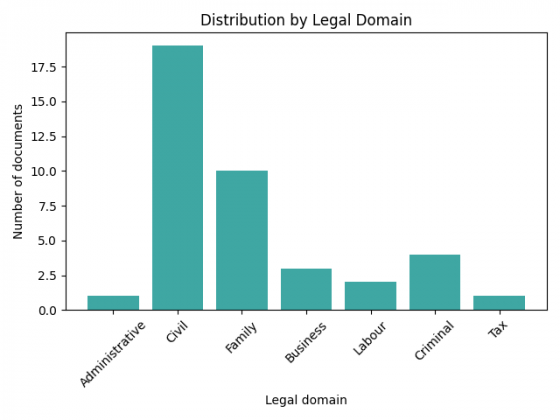
- Legal Areas: The acts are distributed across all major macro-areas of law, including Civil (19 acts), Family (10 acts), Criminal (4 acts), Enterprise (3 acts), Labor (2 acts), Administrative (1 act), and Tax law (1 act).
- Judicial Levels: The collection is balanced to represent all three levels of the Italian judicial system (First Instance, Appeal, and Cassation).
- Metadata Balance: To ensure the corpus is representative, acts are also balanced by geographical location (various seats of the judging body), time period, and the gender of the lawyer.